
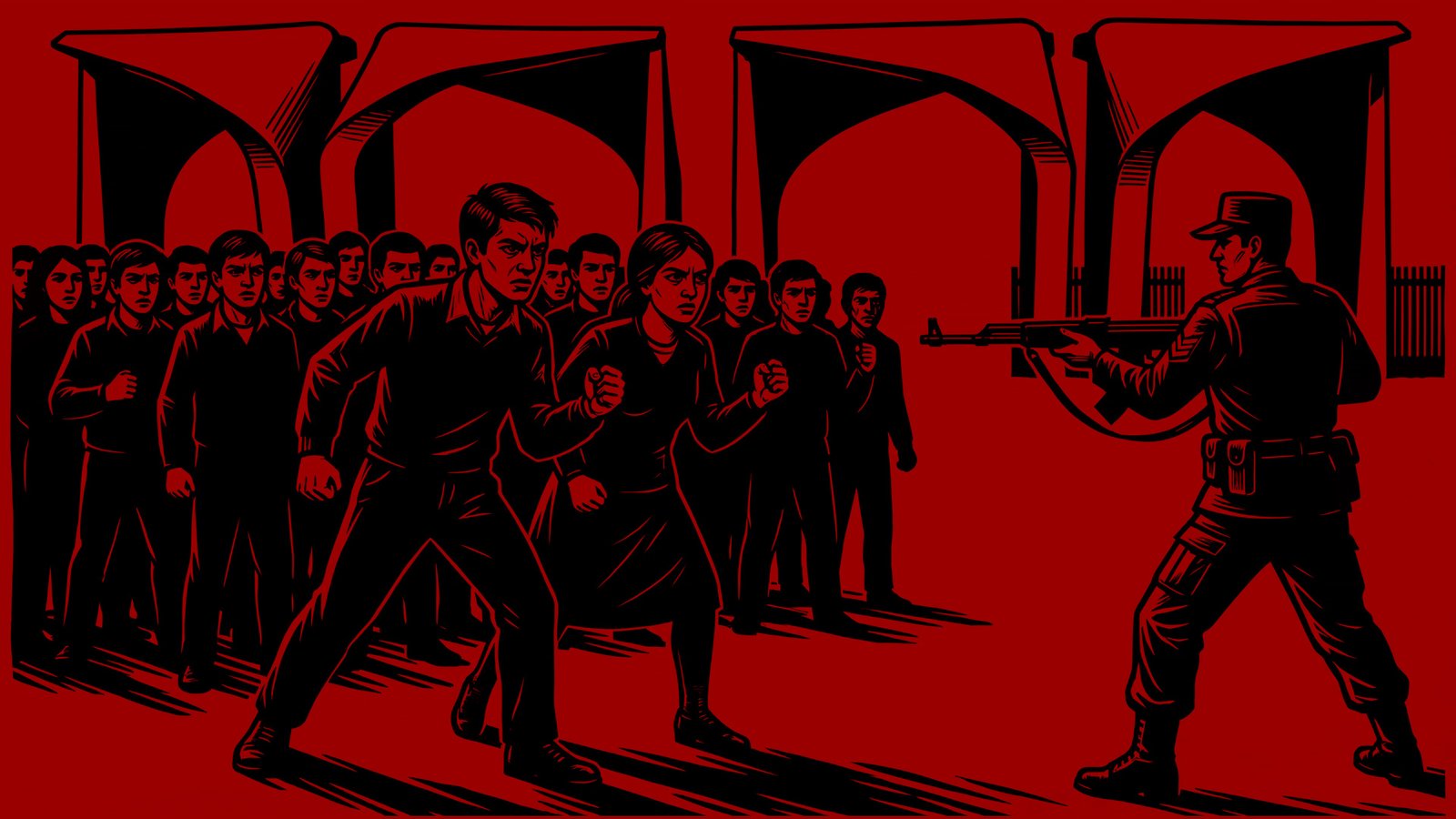
Before anything else, I honor the memory of all those who gave their lives for the freedom of this land;
the memory of those who, for as long as I live, will flow through the veins of my life.
In this essay, let us not forget the people — myself included — who, during the 2022 protests, hoped for military assistance in the face of bullets, and who in the recent protests across various cities repeatedly chanted “Trump, help us” — a voice that must not be ignored.
Bitter End, or Endless Bitterness?
Addressed to the “Reflex Anti-Imperialist Left” That Takes Its Moral Compass from Washington’s Calendar
One: An Open Wound in the Quiet City
Toronto, March 2026.
And here I sit, paralyzed.
Two years since emigrating. Two years learning to live in this “right-thinking” city, a city whose greatest preoccupation is housing prices. Two years trying to explain the difference between “leaving to escape” and “leaving to survive” to myself more than to anyone else. But when the month of Dey 1404 arrived December 2025 all those efforts collapsed.
The seventh of Dey 1404 December 28, 2025 the protests began again. This time from Tehran’s bazaar, from bread lines, from homes that couldn’t keep warm through winter. The rial was in free fall. Inflation above fifty percent, wages that couldn’t buy a few kilos of meat, electricity cutting out, gas nowhere to be found. But people didn’t take to the streets just for bread they came for human dignity.
And the regime answered with what it knows: bullets.
From the very first hours, this uprising was different from those that came before. In November 2019, the crowds were dismissed as “thugs.” In September 2022, as “foreign puppets.” But this time with an economy that had visibly collapsed before everyone’s eyes, with the twelve-day war of June 2025 having shattered the regime’s military prestige before the world, with regional allies falling one by one even the regime’s propaganda machine could not construct a credible story.
I write this essay from within this paralysis, inside my home. From a vantage point where the pain is not of the kind one calls an “analyzable political phenomenon” but of the kind of a severed limb. I carry Iran inside me, not on a map. But carrying this pain is no longer enough. It must be spoken. Names must be read. And with all the anger and precision possible we must speak directly to those who claim their voices are raised but whose ears are closed.
This is not my critique of “the Left.” It is a critique of a left that takes its moral compass from Washington’s calendar: whatever America opposes becomes “resistance”; whatever massacre Washington ignores becomes “complicated.” This is no longer anti-imperialism this is the mirror of imperialism.
Two: The Cartel; A Parasite in a State’s Clothing
Before anything else, a conceptual error must be corrected one that has infiltrated not only the discourse of the “Reflex Anti-Imperialist Left,” but sometimes even the Iranian opposition.
I am aware that by the Weberian definition the monopoly on legitimate violence the Islamic Republic is still formally a “state.” This definition is descriptive, not analytical. But what I am saying is this: a regime whose survival depends on the continuation of killing, and which has no function other than its own perpetuation this is not a state, but a cartel wearing a state’s clothing. States, even the worst of them, are formed to govern society; even the dictatorships of Mussolini and Franco had structures that at least claimed functionality. What rules Iran is a parasitic structure that devours its host not to govern, but to persist.
Kanan Makiya the Iraqi philosopher and architect who dedicated his life to dissecting terror states showed in Republic of Fear how in such systems, “police and security work logically replaces politics.” Fear in these regimes is not a tool it is the fuel of the survival engine. A regime that learns to live on terror can no longer breathe without it. To stop is equivalent to suicide. This military-religious cartel lives as long as it kills. And if it stops killing, it collapses. So killing is not its side activity it is the “work” itself.
Ervand Abrahamian illuminates this organism from the inside in Tortured Confessions. He shows that the system of televised confessions of the 1980s is, in its essence, identical to Stalin’s show trials: the condemned must surrender not only his body, but execute his identity before the camera. Abrahamian writes of prisoners who watched their cellmates’ confessions on television and described it as “as painful as watching a real death.” It is the execution of the soul. And this regime has extracted its legitimacy, its security, and its survival from these spiritual executions from the very beginning, from those same 1980s onward.
Today’s violence is not an “aberration.” It is not an exception. It is the nature of this cartel. When thirteen-year-olds were executed in the 1980s, when a confused teenager spoke in a trembling voice before a camera of his “deviation,” when women whose mothers had been executed begged to be allowed “to return to Islam” it was the same machine operating in the streets of Tehran in December 2025. The numbers have changed. The quality of the crime has not.
Charles Kurzman in The Unthinkable Revolution in Iran opens a deeper layer. He shows that this parasite, from the moment of its birth, concealed its true nature behind a veil of deliberate ambiguity. The ruling clergy in February 1979 spoke in a multilayered language freedom, independence, national identity and it was this very ambiguity that drew liberals, leftists, and the popular masses into support. “It was a revolution in which no one knew exactly what they wanted.” But the clergy knew. The moment they came to power, their monopolizing nature became clear with the massacre of the very revolutionaries who had marched beside them. This pattern of “deliberate ambiguity at the moment of seizing power, then total monopoly” is precisely what any “democratic” project after this regime must also reckon with.
Three: The Great Lie and a Necessary Distinction
Here I must draw an important distinction one whose absence derails the entire argument.
“The Left” is not a monolithic whole. There are three distinct currents that are frequently conflated:
The Reflex Anti-Imperialist Left the current of Chomsky, Corbyn, and much of the European left whose moral criterion is not human suffering, but Washington’s position. If America opposes a regime, that regime becomes “resistance.” If America is silent, that massacre becomes “complicated.” This is the current this essay critiques.
The Anti-War Left Without a Position Sanders, many European social democrats who oppose military intervention and also have nothing clear to say about Iran. Here I acknowledge we are on weaker ground but their error is of a different kind.
The Democratic Human Rights Left Walzer, Kanan Makiya, the Euston Manifesto who are simultaneously anti-imperialist and insist on universal human rights. These are our allies.
The Euston Manifesto written in 2006 by a group of left-wing intellectuals formulated this distinction with explicit clarity: “We shall not make excuses for, or make common cause with, reactionary regimes and movements for which democracy is an enemy.” And more directly: “We reject the double standards that much self-proclaimed progressive opinion now employs.”
This is precisely what we see: that Reflex Anti-Imperialist Left that floods the streets for every martyrdom in Gaza and that concern is legitimate and worthy of support regards the killings of December 2025 as “complicated.” “We must see both sides.” “We must not hand imperialism an excuse.” And with this logic, it places the IRGC’s assault on protesters in the category of “understandable.”
But “anti-imperialism” in its original form was a different moral position: defending subjugated peoples against colonial powers not defending any regime that Washington considers its enemy. When these two are conflated, “anti-imperialism” is no longer a critique of power it is the reproduction of power, just from another angle.
Four: Two Wars, One People in the Middle
But let us step out of abstraction and speak about “war” about what is happening now, in March 2026. Iran today is simultaneously caught in two distinct but intertwined wars. The first is the regime’s war against its own people. The second is the regime’s war against Israel and the West. And the people of Iran without anyone having asked them find themselves in the middle of both.
War One: The Regime Against the People
From the seventh of Dey 1404 when protests began the crackdown was more organized than ever. The Supreme Leader personally issued orders for “decisiveness.” The IRGC and Basij entered with live ammunition shots to the chest, shots to the head, raids on hospitals to arrest the wounded. Amnesty International reported confirmed deaths and injuries within the very first week. Iran International reported in late February 2026 on thousands of documented victims absent from official tallies.
But this time something had changed. Unlike November 2019 or September 2022, the regime was no longer in a position of absolute strength. The twelve-day war of June 2025 had damaged the regime’s military and psychological infrastructure. The Quds Force, which had claimed the mantle of the “Axis of Resistance,” was now grappling with damaged missile systems and a collapsed proxy network. Internal killing for survival had become more unavoidable than ever because the external front no longer maintained the balance.
This historical pattern has been documented by Kurzman: regimes weakened on the outside become more brutal on the inside. A wall that takes a hit from without demands more bricks from within. And this regime’s bricks are the blood of its own people.
And yet two months after the peak of the crackdown, in February 2026 students at various universities gathered again. Remember this. I will return to it.
War Two: Twelve Days That Changed the Equation
June 2025 Israel launched a large-scale military operation against Iran that would later be called the “Twelve-Day War.” The targets were selective and precise: nuclear facilities in Natanz and Isfahan, IRGC air bases in Hamadan and Tabriz, missile command centers. Iran responded by firing hundreds of ballistic missiles and thousands of drones toward Israel but defense systems, with American and Jordanian cooperation, intercepted the bulk of them.
The result of these twelve days was strategically seismic: Iran’s nuclear program was set back years, the IRGC’s air defense system sustained serious damage, and most importantly, the myth of the Islamic Republic’s “invulnerability” to direct attack was shattered.
But for the people of Iran, this war had an even more bitter dimension: they had no role in it, nor did they benefit from its outcome. A regime that had spent years of oil revenues on missiles and proxy forces was now paying the cost of those missiles with further economic collapse. And the burden of that collapse fell on the same people who had taken to the streets for bread in December 2025.
This being caught between two wars is a rare historical paradox: a people who fear both their own regime and the war their regime has launched against others and in both cases, they are the first victims.
Five: Hitchens, Iraq, and Why This Time Is Different
I know that Hitchens applied this very logic to Iraq and the result was catastrophic. This cannot be ignored. The intervention in Iraq did not merely destroy a country; it poisoned the space of legitimate democracy-seeking across the Middle East for an entire generation. Anyone who today speaks of “intervention” must confront this historical shadow.
But the failure of one application does not invalidate the original argument. The fundamental difference is this: Iraq was “liberated” from the outside, by force without an active domestic social movement, without popular consensus, without a ready political alternative. Iran today is something else. The people of Iran took to the streets again two months after the massacre. A society in which “collective psychological reconstruction” has taken place is fundamentally different from a society waiting for a foreign savior.
Hitchens made a mistake in Iraq not in the argument, but in reading the society. I am reading the society. And what I see is this: this movement wells up from within; it has not been injected from without.
Christopher Hitchens who had written about Iraq in A Long Short War formulated this paradox with characteristic sharpness: “What is catastrophic is not the decision to intervene. What is catastrophic is that we allowed a situation to develop over years in which every choice is painful.” This sentence holds true for Iran in March 2026. We have reached the point where “not intervening” is no longer neutrality it is an active choice in favor of the continuation of killing.
Six: Three Thinkers, One Historical Question
Fanon: Collective Psychological Reconstruction Not a License for Violence
Frantz Fanon in The Wretched of the Earth admits two different readings. One is the reading of “revolutionary violence” which Sartre foregrounded in his preface and which remains the most notorious part of Fanon’s legacy. The other is the reading of “collective psychological reconstruction” which I consciously choose, because I believe what we see in Iran today is above all of this second kind, not a top-down project of revolutionary violence.
Fanon argued that the oppressive system colonizes not just the body, but the “mind” of the person. The person under domination learns to see their own worth through the eyes of the oppressor to consider themselves “nothing.” This “nothingness” is not voluntary; the system builds it through humiliation, poverty, fear, and everyday violence.
But Fanon observes something remarkable in the moment the chained person rises in resistance: a return to the self. Not in the sense that violence is “good” but in the sense that the first “no” spoken to a power that has denied your very existence is, psychologically, the act of reclaiming that “existence” which was stolen. “Freedom is not something that can be given” this is the essence of Fanon’s argument.
This argument has an almost direct application to Iran today. The Iranian students who gathered again in February 2026 two months after the killings of December had no project of revolutionary violence. They had a psychological reconstruction. This is why the regime fears them: not their empty fists, but because they no longer allow the regime to define when you deserve to live. The “nothingness” the regime built over forty-some years is broken and no live ammunition can rebuild it.
But Fanon also leaves one unanswered question: what guarantee is there that this psychological reconstruction, after the regime’s collapse, will not simply build another authoritarianism? He gives no clear answer. And it is this question that calls Walzer to the stage.
Walzer: “Supreme Emergency” When Ordinary Ethics Are Suspended
Michael Walzer in Just and Unjust Wars defines a concept of fundamental importance for understanding Iran’s situation: “Supreme Emergency.”
Walzer asks: are there circumstances in which the ordinary rules of the ethics of war protection of civilians, proportionality of action, the prohibition of mass killing may be suspended? Walzer’s answer is precise: yes, but only under two simultaneous conditions: first, the danger must be of an “extraordinarily grave” kind not merely a bad dictatorship, but a threat whose victory would produce consequences “literally beyond calculation.” Second, this danger must be “imminent,” not merely theoretical.
Walzer turns to Nazism for illustration and writes that a regime like Nazism must be seen as “a threat so murderous, so degrading even to those who might survive, that the consequences of its final victory really are beyond calculation.” This is the point at which Walzer says: “Here we are under the rule of necessity, and necessity knows no law.”
Now: the Islamic Republic of March 2026 with the killing of protesters by the IRGC in December of this same year, with a nuclear program that even the twelve-day war did not fully halt, with a proxy network rebuilding in Yemen and Iraq does it meet Walzer’s criterion of “supreme emergency”?
Walzer asks the question directly: “Can a supreme emergency be generated by a particular threat the threat of enslavement or destruction of a single nation? Can soldiers and statesmen override the rights of innocent people for the sake of their own political community?” His answer with hesitation and concern is affirmative. Because in the face of an “ultimate horror,” when options have run out, people do what must be done to save their own people.
But Walzer also draws an important red line: “Supreme emergency is never a stable position. The realm of necessity is subject to historical change. We are obligated to seize opportunities of escape, even to take risks for such opportunities.” In other words: intervention, even if morally defensible, cannot be the end of the story. There must be a plan for “after” and this is precisely where Arendt enters.
Arendt: Liberation vs. Freedom and the Trap That Lies in Wait
Hannah Arendt in On Revolution offers the most subtle warning. She makes a distinction that has recurred throughout all of revolutionary history, yet is rarely understood: the distinction between Liberation and Freedom.
Liberation means being freed from oppression. Freedom means the capacity to build a shared public space a space in which human beings can live together, not merely in opposition to one another. Arendt said liberation is often accompanied by violence and this is an inescapable part of history. But the real challenge is building the “space of freedom” after that violence.
The trap Arendt sees is this: revolutions often stop at the moment of liberation. They know about “being-freed-from-oppression,” but know less about “being-freed-for-what.” And this void is where new authoritarian powers enter. Iran’s own 1979 Revolution was the clearest example of this trap: the masses were freed from the Shah, but the shared political space that Arendt sought never took shape. The clergy, who already knew “for what” they wanted, filled that void.
So Arendt’s lesson for “after the regime” is this: military intervention however morally necessary if not accompanied by a clear political project for “building the space of freedom,” merely exchanges liberation from one oppression for the welcome of another. This warning is not a reason to say “no” to action; it is the responsible condition for saying “yes” to it.
And Arendt has another lesson that is less often read: freedom, if not built in the present crisis, will not be built after the crisis. Freedom means this: that I, now, in this Toronto home, am writing this. That students in February 2026 despite all the danger are gathering again. That we in the diaspora are learning that polite silence is no longer enough.
Seven: The Reflex Anti-Imperialist Left
The Euston Manifesto which Michael Walzer himself, the very Walzer of “Supreme Emergency,” was among the first to sign condemned this contradiction explicitly: “We are opposed to the anti-Americanism now infecting so much left-liberal thought.” And more importantly: “When a state egregiously violates the common life of its people, its claim to sovereignty is forfeit, and the international community has a duty to intervene.”
But what does this same “Reflex Anti-Imperialist Left” say about Iran? Usually a few familiar arguments:
First: “Military intervention makes things worse.” We heard this argument before about Bosnia and those who raised it fell silent while Srebrenica happened. We heard it about Iraqi Kurdistan and the no-fly zone and those who opposed it could never explain why the Kurds are alive today. The failure of Iraq in 2003 was real. But “intervention always makes things worse” is an ideological generalization, not a historical rule.
Second: “We must trust the people of Iran to create change themselves.” This is a beautiful sentence. But for the people of Iran who have stood empty-handed against an armed Revolutionary Guard from the summer of 1988 to December 2025 five decades “we trust you, so we leave you alone” sounds like a polite insult. Trust without support is not kindness it is abandonment.
Third: “Oil… power… geopolitics…” Yes. And precisely for that reason, there is no need to claim that the intentions of any Western government are pure. But the people of Iran do not sit here to cleanse foreign governments of the stain of self-interest. They want to live. And sometimes exactly as in Iraqi Kurdistan, exactly as in Bosnia “impure help” is more honorable than “pure inaction.”
Hitchens formulated this logic with his characteristic sharpness: “If Europe wanted to act and America did not as was the case in Bosnia and Kosovo to whom in practice would authority have been delegated? The answer supplies itself.” The real world works with available tools, not desired ones.
But the most important thing this “Reflex Left” does not see or does not want to see is this: their silence in the face of the killings of December 2025 is not neutral. Silence before power is the endorsement of power. When you have a moral criterion for the killings in Gaza and that criterion is correct but you have no moral criterion for the killings in Tehran and Zahedan, the contradiction is no longer of the kind called “complexity.” It is of the kind called “choice.”
Eight: A Letter to Toronto
I return to this city. To the snow of this March afternoon.
I am not an immigrant who looks at Iran from “outside.” I am someone who carries Iran inside in every Telegram message that reaches me, in every name I read, in every morning I wake and check my phone first, afraid of what I might find.
This paralysis I described at the start this paralysis you also know, all of us Iranian diaspora comes from a strange compound: real fear for those who are there, real anger at those here who stay silent, and the vague guilt of someone who is alive and safe.
But Fanon teaches us something that is also true about this paralysis: staying paralyzed is precisely what this regime wants. Fear, indifference, “what can I possibly do” these are the deliberate products of a terror machine that colonizes not only those who are there, but those who are here too. I took Fanon’s psychological reading not the license for revolutionary violence because I believe what we see in Iran is above all a collective psychological reconstruction. And this reconstruction is not built by missiles, nor by sanctions it is built by the students of February 2026 saying “no” again.
Walzer tells us that “supreme emergency” can be invoked when “both criteria together” are met: “not merely imminence, and not merely seriousness both together.” Both are present today. A regime that still harbors nuclear ambitions, that fires live ammunition at its own people, whose only condition of survival is continuous killing if this is not a “supreme emergency,” then what is?
And Arendt that great woman who herself fled Nazism tells us: freedom must be built right now. Not after “victory.” Freedom means this: that I speak now, write now, now challenge that “Reflex Left,” now refuse to be afraid of the names of those who were killed. This very writing, this very publication, this very “no” to polite silence this too is part of that “space of freedom” that Arendt was searching for.
Nine: The Final Question
I know this essay has no easy answer.
I know “military intervention” brings to mind words like “Iraq” and “Libya” and these fears are not unfounded. I know Hitchens made a mistake applying this very logic, and I record that mistake consciously. I know Walzer himself emphasizes that “supreme emergency is never a stable position” and that one must have a plan for “after.” I know that Fanon alone cannot provide the roadmap for “after the regime” and it is precisely this unanswered question of his that makes Arendt necessary.
But I also know one more thing: when someone is there and is killed in the rain, the philosophizing about “the complexity of the situation” from this Toronto window with its quiet snow, with the neighbor walking their dog is not merely insufficient. Forgive me for saying it: it is obscene.
The right question is not: “Is intervention permissible?”
The right question is: “How many more must die before the moral criterion of that ‘Reflex Anti-Imperialist Left’ extends to Iran as well?”
And if their answer is still silence then let us hold that flag for them until the day they are ashamed of it.
This essay was written from Toronto in March 2026, a city where snow falls and we are paralyzed and we carry their memory.
Sources & References
-
1
A Long Short War: The Postponed Liberation of Iraq — Christopher HitchensPenguin Books, 2003
-
2
Just and Unjust Wars: A Moral Argument with Historical Illustrations — Michael WalzerBasic Books, 1977 — 5th ed. 2015
-
3
The Wretched of the Earth — Frantz FanonGrove Press, 1963 — Trans. Richard Philcox, 2004
-
4
On Revolution — Hannah ArendtViking Press, 1963 — Penguin Classics, 2006
-
5
Republic of Fear: The Politics of Modern Iraq — Kanan MakiyaUniversity of California Press, 1989 — Updated ed. 1998
-
6
Tortured Confessions: Prisons and Public Recantations in Modern Iran — Ervand AbrahamianUniversity of California Press, 1999
-
7
The Unthinkable Revolution in Iran — Charles KurzmanHarvard University Press, 2004
-
8
The Euston Manifesto — Norman Geras, Nick Cohen, Michael Walzer et al.Published 2006 — eustonmanifesto.org

No Comments