
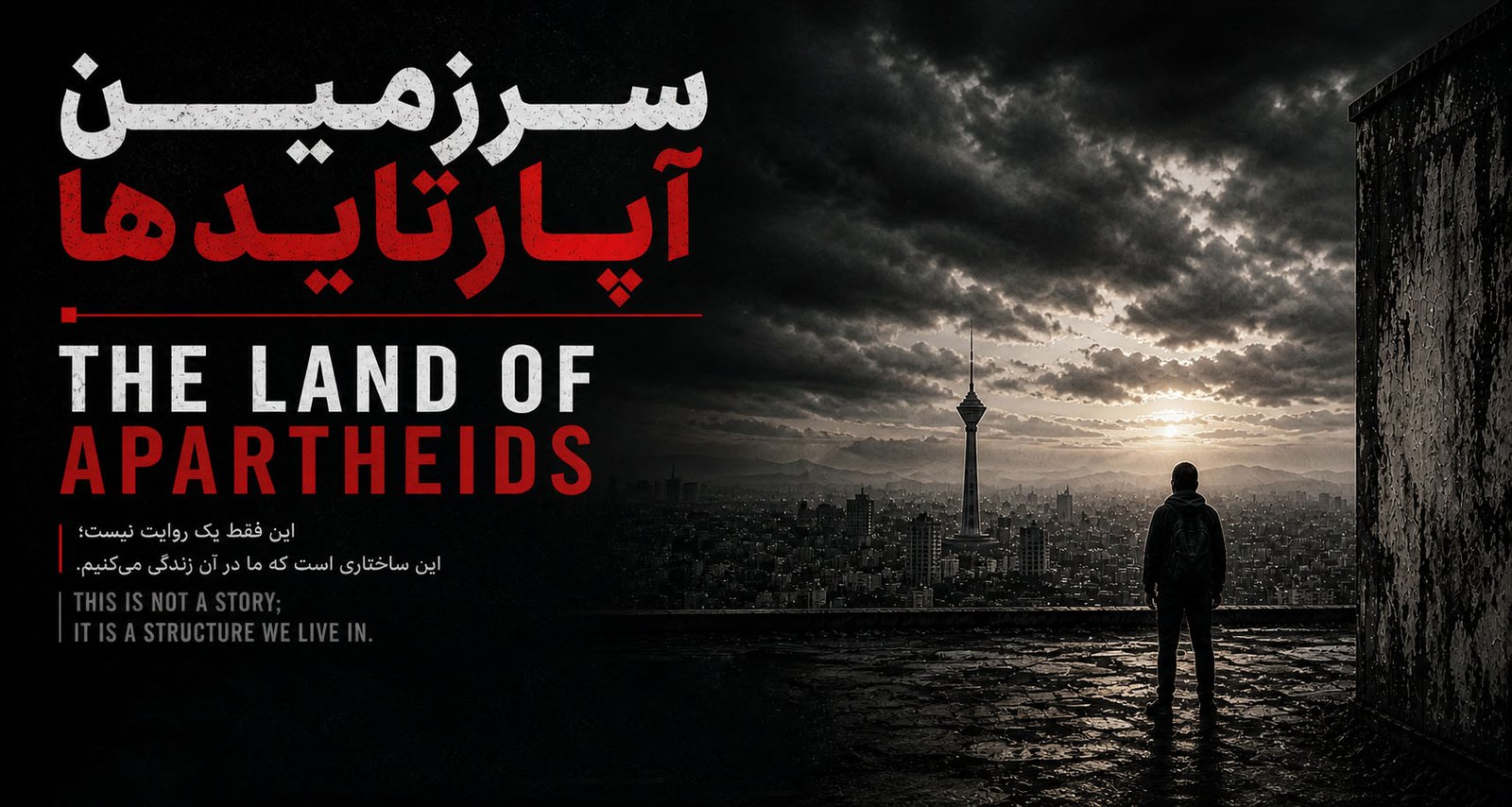
The Politics of Death and the Architecture of Exclusion in Contemporary Iran
“Exile is the unhealable rift forced between a human being and a native place.” Edward Said
One: The Furnace
For two years now, every morning I look out a window onto a street where no one is arrested for what they wear, no one is summoned for a post on social media, and no one speaks carefully because of something said the night before. This freedom this ordinary, simple thing still feels strange to me. I still sometimes catch myself. I still sometimes think there must be something I don’t know. Getting used to the absence of fear is its own kind of work.
I came from Semnan. Then Pardis. Then Tehran. Then here. This journey was a flight from impermanence from an insecurity that had no single name. Not just poverty, not just censorship, not just fear of the morality police or a summons or losing a job. All of it together, simultaneously, in one life, in one body. A constant sense that the ground beneath you isn’t there that tomorrow can take everything back.
I didn’t want to stay in the place I was born and die there. That sentence may sound simple, but let me be precise: I don’t mean I wanted to advance or have a better life. I mean that in Iran, death doesn’t only mean the end of living. Death means gradual erosion. It means surrender. It means accepting that your life belongs to you, but the right to decide about it has been taken away.
What I left behind, what still burns, is a people who couldn’t or wouldn’t or were unable to flee. Those who stayed. The furnace grows hotter every day and they burn more of them with bullets, with the gallows, with torture, with organized deprivation, with daily humiliation. The regime has been killing for years and the world watches.
This essay is an attempt to name what is happening. Not a report, not a slogan an analysis. Because I believe the first step of resistance is seeing clearly what they want us not to see.
Two: The Architecture of Exclusion Space as Politics
To understand Iran, you must start with a simple idea: space is not neutral.
Every road, every checkpoint, every wall, every deprived neighborhood on the edge of a city, every government building whose screams leak through the door these are not accidents. They are the embodiment of a policy. A policy that uses concrete and restrictions on movement to decide who can be where, who has what, and who must remain invisible.
If you look at a development map of Iran not a geographic map, a development map you see one pattern: center and periphery. Tehran and what is not Tehran. Cities that receive investment and provinces that are forgotten. Not accidentally forgotten systematically forgotten.
Sistan and Baluchestan, Kurdistan, Khuzestan, Azerbaijan provinces whose underground wealth is extracted but whose communities are left behind. A young Baluch man lives with unemployment rates twice the national average. A young Kurdish man in Saqqez knows that smuggling goods across the border is the only job the economy offers him and he knows the border guard might shoot him.
Three: The Network of Apartheids
When I say “apartheid” I am not speaking in metaphor. I am speaking in description.
Apartheid means structural separation a system that by design, not negligence, excludes a group of human beings from some part of life. In Iran this system is not singular. It is layered. And each layer presses on the next until the weight of discrimination, for some, becomes lethal.
Gender Apartheid The Body as Legislative Territory
A woman in Iran encounters apartheid through her own body. Not abstractly every day, on every street, in every office. Mandatory hijab is not just a dress code. It is a political declaration: your body is someone else’s legislative territory. Your freedom is not equal to others’. Your presence in public space is conditional conditional on obedience, on the state’s approval of your appearance.
The “Woman, Life, Freedom” movement in autumn 2022 revealed how much of this discrimination had accumulated. Mahsa Amini was not just one victim she was a saturation point. The moment everyone understood it could no longer continue.
Religious Apartheid Illegitimacy by State Decree
In Iran, a Baha’i officially does not exist. Not in the sense of being killed though that has happened but in the sense that the state does not recognize their religious identity. They cannot attend university. They cannot be hired in government positions. Their community has no legal right to assemble. Sunni Muslims who make up a substantial portion of Iran’s population have no right to build a mosque in the capital of their own country.
Economic Apartheid Expulsion from the Cycle of Life
Poverty in Iran is political. Economic foundations connected to the Revolutionary Guard have swallowed large portions of Iran’s economy not through market competition, but through monopoly and patronage. A young person who wants to be an entrepreneur must either have access to connected networks or accept remaining on the margins.
Ethnic Apartheid Punishment for Peripherality
In November 2019, when the regime fired across all of Iran, the most casualties were in Khuzestan, Kermanshah, and Sistan. This was not coincidence. When they kill, they choose where to kill more. This choice is itself a message: peripheral lives are cheaper.
Digital Apartheid Reality as Privilege
Iran has modeled digital control gradually, not overnight. That gradual approach is itself a strategy. Each time something small was added a new filter, a mandatory application, a new regulation it was quiet enough that collective resistance never formed.
Digital coercions began from seemingly harmless places. To receive a government subsidy you had to install an app. To handle insurance you had to register on a state platform. These applications provided services but simultaneously collected data. Location, daily habits, financial behavior. Gradually a complete profile of every citizen was built that could be used against them when needed.
Even reality has become tiered. What you see depends on where you stand.
Now we have reached the tiered internet a project the regime has worked on for years, though like most of its projects it has been implemented imperfectly. The idea is that access to the free internet is no longer a universal right but an “privilege” distributed according to loyalty. Widespread internet blackouts are no longer accidents they are method.
Four: Oil and the Democracy That Never Came
There is a simple political economy that history has repeatedly proven: a government whose revenue comes from underground rather than from taxing its people has no need of its people. Not of their consent, not of their labor, not of their presence as active citizens. When power gushes from oil, you can purchase people instead of being accountable to them.
The Iranian people play no role in the regional decisions made with their oil money, nor do they benefit from its returns but they pay the price in economic sanctions and international isolation. The underground wealth of the country is spent financing the misery of its own people. This may be the most tragic equation in Iran.
Five: The Politics of Death Who Has the Right to Survive
The Islamic Republic’s position on killing is clear.
Iran has one of the highest execution rates in the world. From the mass executions of 1988 to those killed in the protests of 2009, 2017, 2019, 2022, and the winter of 2025 the regime has repeatedly proven that to maintain power it chooses killing. But knowing the numbers is not enough; what matters more is that this killing has a pattern.
First pattern: discrimination in death. In every protest cycle, peripheral regions Baluchestan, Kurdistan, Khuzestan have provided the most victims. Second pattern: purposeless violence humiliation, torture in detention, sexual abuse of prisoners, coerced televised confessions. This violence is for breaking human beings, not confronting a threat. Third pattern: controlling death even bodies of the executed are delivered at night, families sign agreements of silence.
A sovereignty that regards the citizen’s life not as an inherent right, but as a revocable gift.
Six: Winter 2025 When the Furnace Showed Its Full Face
If there was a moment when the regime appeared without a mask, it was the winter of 2025.
The protests of winter 2025 were of a different kind. Not just in scale in the depth of the anger. People who were no longer chanting reformist slogans, no longer seeking change from within. Their voice was clear: we don’t want this structure. The regime’s response was equally clear: bullets. This time the regime didn’t even try to justify itself. It didn’t say “terrorists.” It didn’t say “rioters.” It simply killed.
But these protests did not happen in a vacuum. The regime’s warmongering policies had pushed the country to the edge. Years of financing proxy groups across the region with Iranian oil money, years of threat and tension ultimately ended in military strikes. The country’s infrastructure was targeted. Ordinary people paid the price not those who had made the decisions.
Winter 2025 showed that people have changed. They have moved from “reform” to “transcendence.”
Seven: The Revolutionary Guard A State Within the State
No analysis of Iran is complete without speaking of the Revolutionary Guard not as an army, but as a parallel system.
The Guard was founded in 1979 with a simple mission: protect the revolution. But from that day to this, it has transformed from a military institution into an economic-political-cultural empire. When we speak of the Guard, we must speak simultaneously of an army, an economic holding company, a media apparatus, and a political party.
For a foreign audience: imagine an organization that is simultaneously an army, an intelligence agency, an economic conglomerate, a political party, and a cultural institution and places all of this at the disposal of one person. That is the Revolutionary Guard.
Eight: The Grey Zone Ethics Under Pressure
One of the hardest things to say about Iran is that the continuation of this system is partly guaranteed by those who are themselves trapped in it.
The twenty-year-old soldier who shoots at a protester: from which deprived village did he come? Which university couldn’t he attend? What choice did he have? The office clerk who closes files, leaks information, stays silent: how much is fear and how much is conviction? The teacher who repeats in the classroom what must be repeated where do we draw the line between forced silence and voluntary complicity?
A system that places human beings in the choice between death and complicity commits its worst crime in this: it turns you into its own instrument. I say this not to forgive anyone but because to truly resist authoritarianism, you must understand how it works.
And among all this, there is something worthy of admiration: those who stayed in the grey zone and did not become grey. Teachers who told the truth despite all the pressure. Workers who struck despite all the threats. Students who chanted despite all the danger. These are the small heroes of Iranian history.
Nine: Witnessing Pain The World’s Responsibility
The world watches. UN reports, Human Rights Council resolutions, articles in major newspapers, tweets from Western politicians all are informed. All are “concerned.” All “condemn.” And the furnace keeps burning.
International media operates on crisis logic: a major protest erupts, heavy coverage, global concern. Then it is suppressed. The news wave recedes. Coverage diminishes. The world forgets. The system continues. The regime understands this pattern well and counts on it.
Every government that continues trading with the Islamic Republic without human rights conditions is complicit in what is happening.
Ten: Internal Exile When Home Is No Longer Safe
When I left Iran, I thought exile meant being in a place that isn’t your country. I was wrong.
Many of my compatriots have lived in exile at home for years. A young person in Zahedan whose language is forbidden at school. A woman who cannot leave the country without her husband’s permission. A teacher imprisoned for belonging to a professional union. A professor expelled from the university for having the wrong views. They are all in Iran in their own homes and all of them are in some kind of exile.
Home is where you are free. In Iran, where can you be free? Within the four walls of your house, as long as the internet hasn’t been cut and the Basij hasn’t come to the door. This is not a home. It is a cage whose walls are law.
Eleven: Those Who Left The Question of Staying or Going
I want to speak about guilt. Not guilt in the religious sense. Guilt as in that feeling that comes at night the question: was leaving a form of abandonment?
The structure is this: whoever can leave, leaves. And the best ones can usually leave. This gradual exodus this continuous departure of those most capable of creating change leaves society more depleted. But at the same time, leaving is sometimes the condition of survival. Staying and resisting is courageous. But staying and being crushed helps no one, not even yourself.
Leaving is not the end of responsibility. Perhaps it is the beginning of a different kind of responsibility. Do we merely assimilate? Or does this freedom become a tool for saying what cannot be said inside? I choose the second. Perhaps it is not enough. But it is the only thing I can do.
Twelve: Five Centuries Historical Roots
To understand today’s Iran, you cannot start from 1979. Iran has lived with a fundamental tension for five hundred years: the competition between the institution of the state and the institution of religion. From the Safavids who made Shi’ism simultaneously the official religion and a political instrument through the Qajars who faced and failed against the West, to the Constitutional Revolution which was the first serious attempt at democracy, to Reza Shah who brought authoritarian modernity, to Mossadegh who touched the dream of independence by nationalizing oil and was overthrown, to the revolution of 1979 this historical line has been one continuous question: what does Iran want to be?
But this long history says something else as well: Iran is resilient. The Constitutional Revolution failed, but the desire for democracy did not die. Mossadegh was overthrown, but the idea of independence survived. The Green Movement was suppressed, but the demand for freedom did not sleep. “Woman, Life, Freedom” came. The winter of 2025 came. And it still continues.
Thirteen: From Watching to Acting A Proposal for the World
The Islamic Republic has continued for forty-five years. Not because it is strong it has never been this weak, never this hated by its own people. It has continued because the global structure has allowed it to continue.
Unconditional trade supplies the regime’s financial resources not resources that reach the people, but resources that keep the furnace burning. Unconditional diplomacy sends the message that killing people has no cost. And the short news cycle allows the regime, after each crackdown, to simply wait until the world forgets.
For the foreign reader: know your own country. Know what relationship your government has with Iran. Pressure for those relationships to be conditional on human rights progress. This is not enough, but it is necessary.
End and Beginning
The land of apartheids is still burning.
I see it from Toronto. From this distance that is sometimes peaceful and sometimes unbearable. From this freedom that resembles a blessing and resembles a debt.
This essay did not say everything that needed to be said no essay can. But I wanted one thing: to name. To name precisely what is, without decoration and without censorship.
Iran can be something other than this. Its people deserve something better than this. And that deserving has never been conditional on obedience.
Bahram Rameh
Toronto, Spring 2026
No Comments