
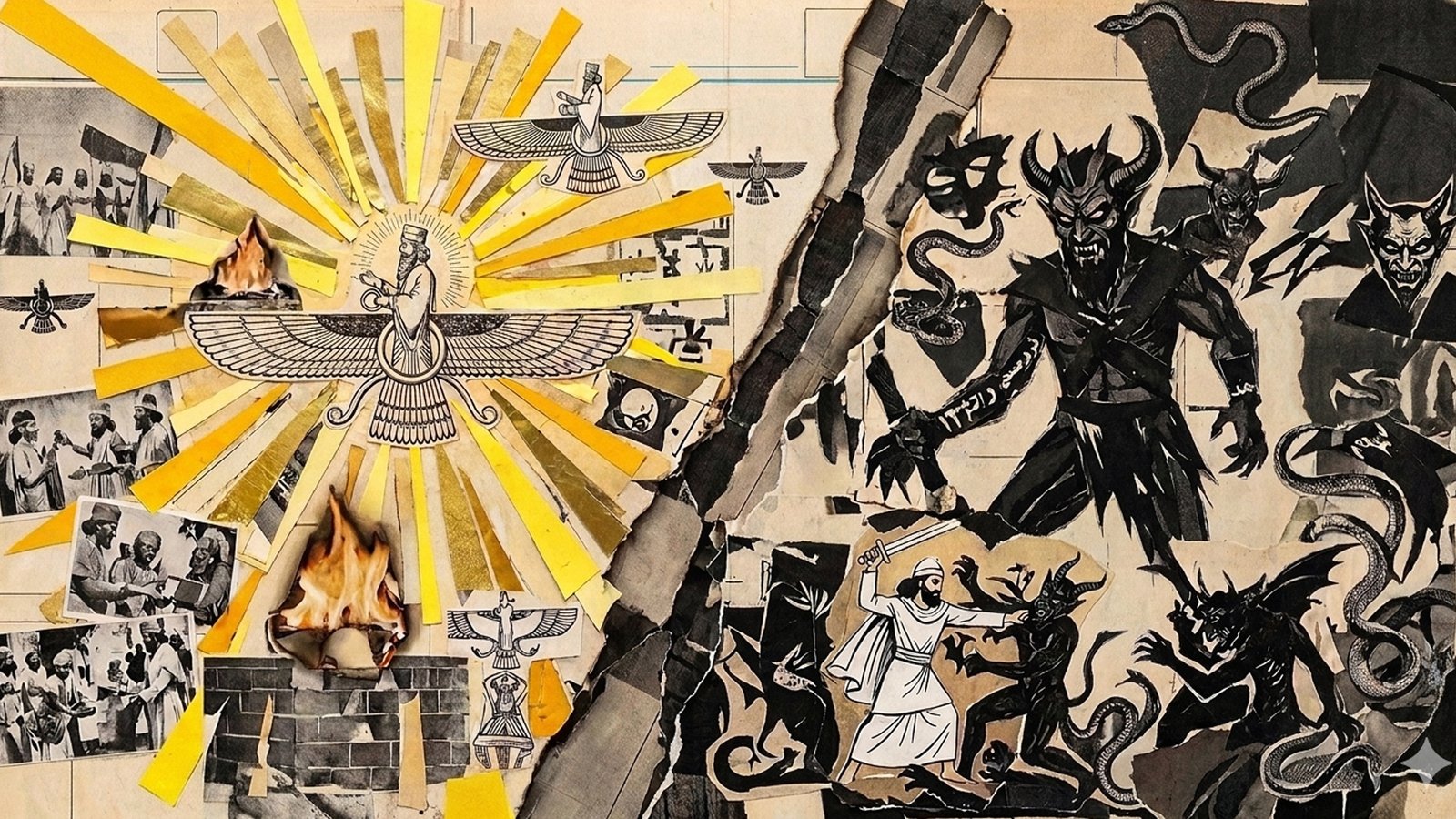
Before anything else, I honor the memory of all those who gave their lives for the freedom of this land;
the memory of those who, for as long as I live, will flow through the veins of my life.
“The Deception of Dualism and the Tragedy of Permanence”
A Genealogy of Binary Thought in the Iranian Lifeworld
Preface: A Confession Before the Mirror
These words are, more than a critique of any particular current or a judgment of others, the author’s search for the roots of a “shared wound.” This essay is a dissection of that rigid, deeply sedimented mental structure which has nested within all of us regardless of which side of the field we stand on. The author does not consider himself exempt from this structure; for if the reader sees only “the other” in these pages, the essay is speaking precisely about this universal “blind spot.”
These lines were written with empathy and with an acknowledgment of a “collective stasis.” We know well that attachment to a path, a leader, or a movement is often of the pure substance of “hope” and hope cannot and must not be condemned. Yet our turbulent history has repeatedly demonstrated how a tremendous chasm opens between “leadership” and “messianism”: the leader is accountable and the messiah is immune; the leader is an instrument in the hands of the people, but the messiah himself becomes “the people’s purpose.”
This essay is a humble invitation to reconsideration; a summons for the informed citizen who strives, while remaining “loyal,” to stay “sharp-eyed” and who, while standing behind a conviction, does not close their eyes to its contradictions. This is not a sign of doubt or weakness, but the highest form of political maturity, and the only small aperture that may perhaps save us from the repetition of the tragedy of permanence.
Introduction: Politics as Imaginary Theology
In contemporary Iran, politics resembles a mythological drama more than it does an arena of “earthly interests” or “structural negotiation.” We breathe in a space where every political rivalry, every conflict of interests, and every social crisis is immediately dissolved in the furnace of absolute metaphors. Our language from the grandiloquent manifestos of the opposition to the sermons of the establishment is saturated with binaries that foreclose any “complex understanding”: right against wrong, light against darkness, salvation against ruin. This “epistemic freezing” is not the accidental product of a political situation; rather, it is rooted in the depths of the intellectual and psychological history of a people who have always, between “being” and “appearing,” between “static truth” and “fluid reality,” sacrificed the latter for the former.
The central question is this: why does the Iranian mind, when confronted with ambiguity, fall into anxiety? Why do we perpetually seek refuge in pre-defined, definitive answers? This flight from the “grey zones” and retreat into absolute black and white is rooted in a cycle of “the art of non-thinking.” This essay is an attempt at a genealogy of this “binary mind” from the depths of ancient myth to the contemporary collective unconscious. Our central thesis is that the “ancient mythological dualism” (the battle between Hormozd and Ahriman) has been deposited in the collective unconscious of Iranians and, in the modern era, has been reproduced in the form of din-khuyi (religious habituation) and the “psychological projection of the shadow.” Until this mental structure is deconstructed, every change in the realm of power will be nothing more than a displacement of the locus of despotism. We need to migrate from “mythological belief” to “civic consciousness” a migration that passes through the threshold of accepting “the tragedy of the textured human.”
1. Cosmic Genealogy: The Genetic Map of Hormozd and Ahriman
To understand today’s intellectual impasse, we must drill into the underlying strata of Iranian ontology. Mehrdad Bahar, in From Myth to History, drawing on texts such as the Bundahishn, demonstrates that dualism is not a choice but the very backbone of the Iranian worldview since antiquity. In our mythology, existence is a minefield occupied since the dawn of time by two opposing poles. This is not merely a moral battle between good and evil; it is an ontological demarcation.
According to mythological geography, “Khvaniratha” (Iranvij) lies at the center of the world and the domain of light, surrounded on every side by “Aniran” (the non-Iranians) who are besieged by darkness and Ahriman. This spatial division has created a “tremendous symmetry” in our minds. In this cosmology, the human being is not a neutral observer; they are a “soldier” cast from birth into the midst of a cosmic battle, obligated to fight for the ultimate victory of light. This “duty” leaves no room for “doubt.” Any hesitation about the authenticity of the camp of light means falling into the trap of Ahriman.
This mythological structure has reproduced itself in rituals such as Nowruz. For the Iranian psyche, Nowruz is not merely a calendrical transition but a symbol of the “inevitable victory” of light over darkness, and of warmth over the Ahriman-like cold. This “teleological” vision which holds that ultimate victory belongs to one’s own side has been injected into contemporary politics. Instead of analyzing the balance of forces, we perpetually seek that “Nowruz moment” of politics: the moment when darkness is to be completely extinguished. This “mythological belief” prevents us from seeing politics as a realm of “possibles”; for us, politics is always a realm of “sacreds.”
2. The Fortress of Language and the Epic of Identity: The Legacy of Shahrokh Meskoob
If myth is our genetic map, the “Persian language” and “epic” are the walls that have preserved this map from the gales of historical catastrophe. Shahrokh Meskoob, in Iranian Identity and the Persian Language, dissects how Iranians, following devastating historical collapses from the fall of the Sassanids to the Mongol invasion reconstructed their identity in the shelter of “language.” In this reconstruction, the Shahnameh is not merely a book of poetry; it is the “psychological history” of a people that refused to dissolve into the darkness of the “other” (the Arabs or the Turanians).
Meskoob shows that within this linguistic fortress, “being Iranian” became intertwined with “being luminous.” Our epic hero is as much a champion as he is the embodiment of “divine good.” But this reconstruction of identity came at a heavy cost: a rigid boundary between “us” and “them.” In our collective unconscious, every external phenomenon or every different idea is perceived as a threat to this “identity fortress.”
The great danger lies here: when identity is built upon the “negation of the other,” the mind becomes prone to binary polarization. In the modern era, this epic structure has seeped into the politics of both the diaspora and the homeland. We see the political opponent not as a rival but as “Zahhak” or “Afrasiyab.” This epic vision cannot abide the reality of the “fallible human being”; one must either be a luminous hero or a demon of darkness. This “absence of a middle ground” in thought has meant we are unable to analyze structures of power as human and earthly phenomena. We are perpetually reproducing the same battle of Rostam and Esfandiyar a battle in which both sides insist on their absolute righteousness, and whose end is nothing but tragedy and destruction.
3. Din-khuyi and the Suicide of Reason: A Dissection by Aramesh Dostdar
But how did this mythological and epic structure become, in the modern era, an intellectual impasse? The answer must be sought in the concept of din-khuyi. Aramesh Dostdar, in his groundbreaking work Dark Luminescences, warns us that din-khuyi does not necessarily mean religious faith or traditional piety; rather, it is a kind of “mode of being in the world.” Din-khuyi is a comportment in which truth is pre-existent and the human being’s duty is not “discovery” but “justification” and “compliance.”
In a din-khuy culture, “doubt” is not treated as an epistemological tool but as something “Ahrimanic.” Thinking requires openness toward ambiguity, but the Iranian din-khuy mind, having been built on mythological certainties, is terrified of any “foundational questioning.” Dostdar argues that even our modern intellectuals from the left to the liberal have remained din-khuy in the deeper layers of their minds. They have merely changed the “idols,” but not the “idol worship.”
When a political activist calls their own camp “pure light” and interprets every critique as paving the road for the enemy, they are in practice exercising “the art of non-thinking.” This “refusal to think” is the root of all our political dead ends. The binary mind, because it cannot confront the “shadows” within itself, is compelled to divide the world into a “sacred us” and a “cursed them.” In this system, politics is removed from the domain of “critical reason” and hurled into the domain of “ideological faith.” Instead of seeing phenomena in their grey layers, we consume them in black-and-white packaging to free ourselves from the anxiety of thinking. This “suicide of reason” is the price we pay to preserve the hollow symmetries of our minds.
4. The Psychopolitics of Projection: The Shadow and the Birth of Ahriman in the Mirror of the Other
If din-khuyi constructs the epistemological foundation of the binary mind, the mechanism of “shadow projection” supplies its emotional and psychological fuel. Carl Gustav Jung, in his seminal work Man and His Symbols, speaks of a concept that is perhaps the most critical tool for understanding our political hot-headedness: the “Shadow.” The shadow is that part of our personality which, due to its incompatibility with the ideals of the conscious self, has been repressed and ignored. We tend to see ourselves as entirely “luminous, righteous, and civilized”; consequently, we drive all violence, humiliation, and the will to suppress which exist in the depths of our being down into the basement of the unconscious.
Catastrophe in the political domain occurs when this unrecognized shadow is projected onto “the other.” Jung explains that when the human being is unable to face the darkness within, they see it in the face of the enemy. In Iranian psychopolitics, this mechanism has reached its fullest expression. Political currents whether the establishment or the opposition see the enemy not as an “earthly rival” but as the “absolute embodiment of their own shadow.”
When we define the enemy as “absolute evil,” we are in fact unloading the burden of our own sins and shortcomings onto them. This act transforms the enemy, in our minds, into a “mythological monster.” The danger of this monsterization is that it portrays the enemy as “invincible” and “supra-human.” A monster cannot be neutralized through structural analysis or political balance of power; a monster must be fought until one side is annihilated. Jung warns that “the brighter the light of consciousness, the darker the shadow of the unconscious.” The one who considers themselves an “angel of salvation” inevitably must construct an enemy of utmost “diabolism” to balance the scales of their mind. This “tremendous symmetry” keeps us in a state of perpetual war, because we are never willing to admit that part of the “darkness” we see in the enemy is a trace of our own repressed impulses.
5. From “Transcendent Devil” to “Banal Bureaucrat”: Hannah Arendt’s Lesson
Against this mythological tendency toward monsterization, we need an “Arendtian consciousness.” Hannah Arendt, with her historical account of the trial of Adolf Eichmann, introduced the staggering concept of the “Banality of Evil.” She demonstrated that the greatest crimes of humanity do not necessarily stem from a deep, transcendent malice, but are the product of “bureaucratic systems” and ordinary people who “do not think.”
In Iran’s political landscape, we are constantly caught in the trap of “radical evil” imagining that we face Ahrimanic creatures who have come from another planet. But Arendt tells us that evil can be profoundly superficial and bureaucratic. Linking this concept to Dostdar’s din-khuyi yields a precise picture of our impasse: the structure of repression in Iran is not nourished by “Ahriman’s magical power” but by the “refusal of individual thinking.”
When we call the enemy “absolute evil,” we unwittingly remove them from the domain of structural critique. But if we accept that we are facing a “banal system” whose primary fuel is the “non-thinking” of its components (and at times even of ourselves) then the possibility of effective political action emerges. The real struggle is not an “exorcism” to banish demons, but an effort to reclaim “individual judgment” against the bureaucracy of non-thinking. Arendt teaches us that to change a dreadful situation, one must not seek “miracles” but must recognize “the mechanisms of banality” and dismantle them.
6. In Defense of the “Suffering Human” Against the “Superhero”: Dostoevsky’s Antidote
For breaking the cage of the binary mind, there is no more effective remedy than the literature of Fyodor Dostoevsky. His “Underground Man” in Notes from Underground is precisely the antidote to that “ideal, luminous human being” which our myths promise. The Underground Man declares with unflinching candor: “I am a sick man… I am a spiteful man.” With this confession, he demolishes all binary structures of “good and evil.”
In our political thought, we have always sought a “flawless hero” or an “angel of salvation” to come and slay the dragon of darkness. But Dostoevsky shows us that the real human being is a compound of paradoxes; they can be at once abject and brilliant, spiteful and yet thirsting for love. The Underground Man rebels against the logic of “two plus two equals four” the logic that seeks to reduce the human being to a mathematical formula or a chess piece.
The Iranian binary mind cannot tolerate the “textured human.” We either “canonize” someone or “demonize” them. But Dostoevsky teaches us that “truth” lies in these dark, suffering underground spaces, not in the grandiloquent slogans of the camp of light. Accepting internal contradictions and seeing the human suffering on both sides of the front is the only way out of “mythological belief.” We need to move from “ideal ethics” which always leads to the elimination of the non-self toward “tragic ethics”: an ethics in which “the right to err” and “the complexity of the soul” are recognized.
7. Bahram Beyzai: Deconstructing the Hero’s Mask and the Tragedy of Permanence
If Aramesh Dostdar strikes at the root of din-khuyi with the axe of philosophy, Bahram Beyzai, through his dissection of dramatic mythological structures, stages the “tragedy of permanence.” In all his works especially in the monumental Where Is the Thousand Myths? and the masterpiece play Death of Yazdgerd Beyzai shows how our history is a performance written by the “victors” to render the iron binaries eternal.
In Death of Yazdgerd, we confront the moment of collapse of a mythological grandeur. The king who was the embodiment of light has now taken refuge in a ruined mill. But instead of the usual heroic narrative, Beyzai introduces the “multiplicity of truth.” Who killed the king? The priest? The general? Or the miller who had been broken by poverty and oppression? Beyzai here deconstructs the “hero’s mask.” He shows that “evil” is not a metaphysical, external matter, but the product of circumstance, fear, and years of suppression of society’s underlying strata.
Beyzai teaches us that “permanence” in pre-determined roles the luminous king against the dark Arabs is the very cage that has imprisoned us in history. In his works, he speaks of the “missing part” of the narrative: those who stand on the margins of history (like the miller’s wife) but who narrate the real truth of power. Beyzai’s art is an exercise in seeing the “suffering texture of reality” in places where binary politics seeks only “entrenchment.” By shattering mythological symmetries, he takes us on a journey whose end is not the victory of one pole, but a painful awareness of the complexity of our shared human fate.
8. Cultural Schizophrenia and the Metamorphosis of Tradition: A Dissection of Hybrid Consciousness in Shayegan’s View
To understand the reason for the binary freeze in the Iranian psyche, one cannot avoid confronting the ideas of Daryush Shayegan. In his works especially in the unsettling essay “The Ideologization of Tradition” Shayegan lays his finger on a wound that, more than ever, has reopened in the turbulence of diaspora politics and the domestic Iranian scene. He argues that we dwell in a condition called “cultural schizophrenia”: a state in which we are suspended between two incompatible worlds transcendent tradition and technological modernity and, unable to construct a “coherent whole,” take refuge in “cutting and pasting.”
In Shayegan’s view, the real catastrophe is not our modernization but the “metamorphosis of tradition.” He explains how “tradition” which in the past was a space for intuition, mysticism, and semantic openness was transformed, in encounter with the intellectual tools of the West (such as nineteenth-century totalizing ideologies), into an “ideological weapon.” This is what he calls “unconscious Westoxification.” The paradox is this: even the most ardent anti-Western currents in Iran are, in fact, using Western “binary logic” to suppress their own roots. They have turned tradition into the terrifying blade of ideological inquisitors.
This hybrid, or “false,” consciousness intensifies binary imagination. The schizophrenic Iranian, unable to resolve their internal contradictions, seeks a “false unity” outside themselves. They need to divide the world into “absolute right” of which they are the embodiment and “absolute wrong” which is the other in order to be saved from the anxiety of floating in history. Shayegan reminds us of a concept he calls “vacation from history”: we have stepped outside the real course of time and live in a “mythological time” in which a final battle is supposed to untie all knots. This ideological view of tradition not only fails to connect us to our roots; by destroying the “grey texture of culture,” it imprisons us in the eliminationist dead end of “us or them.”
9. Deconstructing Toxic Oppositions: The Logic of “Trace” and the Collapse of Symmetry
At this stage of the dissection, we must shake the boundaries of this intellectual cage with Jacques Derrida’s drill. Derrida, in his foundational work Of Grammatology, shows that all totalitarian systems of thought are built upon “hierarchical binary oppositions.” In these oppositions, one side light, presence, good, us is always assumed to be authentic and superior, while the other darkness, absence, evil, the other is marginalized as a “deviation” or “secondary matter.”
But Derrida, with his revolutionary concept of the “Supplement,” deconstructs this game. He argues that the dominant pole depends heavily on the very pole it demeans in order to define itself. In other words, “light” has no meaning whatsoever except in opposition to “darkness.” The catastrophe of the Iranian binary mind is that it imagines it can surgically excise “darkness” the enemy, the other entirely and discard it in order to achieve “absolute purity.”
Deconstruction teaches us that every phenomenon carries within itself the “trace” of its opposite pole. There is no “pure us” that is uncontaminated by “them.” When political currents speak in an eliminationist language of “completely purging the enemy,” they are in fact producing a dangerous xenophobic illusion. The effort to achieve “the pure presence of good” always ends in violence; for to completely eliminate darkness, every form of “difference” and “ambiguity” must also be eliminated. Salvation lies not in the victory of one pole over another, but in the acceptance of this deconstructive truth: that “the other” is a part of the definition of “the self.” Exiting the dead end of dualism requires accepting that every “luminosity” always carries within it a shadow of the same darkness it claims to be fighting.
10. Final Synthesis: From “Mythological Faith” to “Tragic Maturity”
Now all the threads of this inquiry converge at a single point: the necessity of migrating from myth to consciousness. We began with the “genealogy of ancient dualism,” passed through “Meskoob’s fortress of language,” split open the dead end of “Dostdar’s din-khuyi,” faced “Jung’s shadow,” recognized “Arendt’s banality of evil,” saw our masks in “Beyzai’s mirrors,” and finally, with “Shayegan and Derrida,” arrived at the deconstruction of our fragmented identity.
The bitter, and at the same time liberating, truth is this: victory over darkness is neither a calendrical event nor a revolutionary promise. Real victory is a “cognitive revolution” the moment the Iranian person dares to step outside the cage of binaries. This maturity crystallizes in three domains:
A) Politics as Responsibility, Not Exorcism
Politics is not the domain of theology. The enemy is not a “transcendent devil” who disappears with political incantations; the enemy is a “banal human system” in Arendt’s terms that feeds on our absolute hatred as well. As long as we face the enemy as an invincible monster, we have granted them supra-human power. Civic engagement means seeing the mechanisms of power without contaminating them with Ahrimanic metaphors.
B) Accepting the “Shadow” and Dissolving the Savior
As long as we project all malevolence onto “the other” and call ourselves “soldiers of the camp of light,” we are reproducing the very eliminationist logic of despotism. Political maturity means accepting that part of that “darkness” is within us. Waiting for the emergence of the “luminous hero” who will slay the dragon in Dostdar’s terms is only an extension of our period of immaturity. The savior is in the mirror: a human being who accepts their own contradictions and, instead of “absolute purification,” seeks “possible justice.”
C) Tragic Ethics Against Mythological Faith
We need a “tragic ethics” an ethics in which “Dostoevsky’s textured human” triumphs over the “cardboard hero”; an ethics that places “the reduction of today’s suffering” above “the promise of tomorrow’s paradise.” We must be able to live in the grey zones without losing our moral compass.
Coda: A Return to “the Human Being”
The tragedy of permanence comes to an end when we return from “adjectives” to “the human being” when, instead of the battle of light and darkness, we choose the language of “rights and structures.” This change does not begin in political conferences; it begins in “the private room of each citizen.” But this theoretical synthesis immediately places us before the most formidable practical question: when the myth of the savior collapses and leaders too are revealed in their own contradictions, how ought one to stand?
11. Awakening in the Age of the Bankruptcy of Saviors
What we experience today in the dust-laden atmosphere of politics that biting sense of disillusionment with “self-proclaimed leaders” and “clamorous factions” is, in truth, not a defeat but the magnificent moment of an inevitable awakening. The reality is that many of those who have donned the mantle of leadership, or the partisans who persist on both sides of the arena in the same eliminationist logic, have unwittingly become the perfect mirror image of the very thing against which they rebelled. Their personal contradiction lies precisely here: they speak of liberation, but in language and deed reproduce the same “angel and demon” vision.
We must be honest with ourselves: we often take refuge in these leaders because “freedom” and “the responsibility of thinking” are a heavy burden. Surrendering the reins of the mind to a savior is a psychological sedative to free ourselves from the anxiety of solitude in history. But a leader who has not yet recognized their own inner shadows only promises “a new darkness.” The radicalism of factions is, in truth, a flight from the responsibility of “individuality” they keep the world binary because in a grey, human world, no one needs a “legendary hero” anymore. We must learn that the enemy is not a metaphysical Ahriman who disappears with this or that political incantation; the enemy is a bureaucratic, human system that draws its primary fuel from “our symmetrical hatred” and “our individual forgetting.”
12. Epilogue: The Glory of Standing in the Midst of Fog
Liberation begins from the moment we accept that real power lies not in the hands of leaders, but in our capacity for “living within the circle of truth.” This means refusing to become a pawn in the game of those who themselves struggle in their personal contradictions. Personal responsibility means remaining awake where everyone prefers to sink into the pleasant slumber of an ideology or a new savior.
The informed citizen is one who, in the midst of upheaval, knows “bounds and limits.” They know that if, in the pursuit of freedom, they ignore the complexity of the opponent and seek absolute elimination, they themselves have become the next tyrant. Personal responsibility means the courage to stand in grey space; it means refusing to accept simplifying narratives; it means understanding this truth: that “thinking,” by itself, is the most audacious political act.
The future of Iran rests not on a calendrical miracle, but on that very summons which Kant called the foundation of Enlightenment: the courage to use one’s own understanding. We must free ourselves from the deception of duality so that we can stand on the ground of reality not as soldiers in a cosmic battle, but as citizens with open eyes. This is the only path that opens from the tragedy of permanence toward the horizon of freedom not the arrival of a new savior, but the collapse of our need for a savior.
Notes
- Dualism: A philosophical-religious system based on the opposition of two fundamental and incompatible principles, such as good and evil, light and darkness. In Zoroastrian cosmology, this dualism is expressed as the battle between Ahura Mazda (Hormozd) and Ahriman.
- Bundahishn: A Pahlavi (Middle Persian) text from the Sassanid era containing information on cosmology, creation myths, and the mythological geography of ancient Iran. Its name means “Primordial Creation.”
- Teleological: A view that explains every phenomenon in terms of its ultimate goal or end. Teleological thinking in politics means that history has a pre-determined course toward the final victory of one side.
- Din-khuyi: A concept formulated by Aramesh Dostdar in Dark Luminescences. Din-khuyi means a mode of being in the world in which truth is assumed to be pre-given and complete, foundational questioning is prohibited, and the human being’s duty is merely to follow and justify, not to discover and critique. This concept is not necessarily equivalent to religious belief.
- Shadow: A concept from Carl Gustav Jung’s analytical psychology. The shadow is that part of the personality deemed incompatible with the ideal self-image of the conscious mind, and is repressed or concealed. When an individual or collective does not recognize their shadow, they project it onto “the other.”
- Projection: In psychology, the process by which an individual attributes feelings, impulses, or characteristics that they cannot accept in themselves to others. Jung considers shadow projection one of the primary roots of prejudice and enemy-construction.
- Banality of Evil: A concept introduced by Hannah Arendt following her report on the trial of Adolf Eichmann (1961) in Jerusalem. Arendt argued that Eichmann was not a monstrous villain but an ordinary bureaucrat who participated in crime by suspending his faculty of judgment. This concept demonstrates that great evil does not necessarily arise from diabolical intent.
- Textured Human: Used in this essay to refer to a human being who possesses complex layers, internal contradictions, and moral ambiguities, and who cannot be understood within the binary frameworks of “hero or enemy.” This concept stands in contrast to the “ideal human” or “cardboard hero.”
- Deconstruction: A philosophical method developed by Jacques Derrida. Deconstruction shows that every text or conceptual system contains internal contradictions, and that concepts treated as “originary” depend on the “other” which they marginalize.
- Supplement: A concept in Derrida’s philosophy showing that what is set aside as “supplementary” or “secondary” is in fact necessary for completing and defining the original. In this sense, “the other” plays a constitutive role in the definition of “the self.”
- Trace: A concept from Derrida indicating that no element in a system of meaning is self-sufficient or pure; every element always carries within it the trace of other elements. For this reason, “complete purification” from the other is impossible.
- Cultural Schizophrenia: A term used by Daryush Shayegan to describe the condition of societies caught between two incompatible horizons transcendent tradition and technological modernity and unable to construct a coherent whole.
- Metamorphosis of Tradition: A concept Shayegan raises in his analysis of Iranian culture. When tradition, instead of being a space for intuition and mysticism, comes into contact with nineteenth-century Western ideologies and is transformed into a “political weapon,” it has undergone “metamorphosis.”
- Epistemic Freezing: The arrest of the knowledge-production process and the mind’s inability to process ambiguity and complexity. In this essay, it refers to a condition in which pre-defined binaries replace critical thinking.
- Khvaniratha (or Khwaniratha): In Iranian mythology, the most central and largest of the seven countries (climes) of the world, in which Iranvij is located. According to mythological belief, this land is the heart of light and the principal site of battle against Ahriman.
- Diaspora: The dispersal of members of a nation, ethnicity, or cultural group outside their original homeland. In this essay, it refers to the community of Iranians outside the country who, despite their distance from the homeland, continue to engage with Iranian identity and politics.
- Enlightenment (Aufklärung): The European intellectual movement of the eighteenth century, whose emphasis was on reason, science, and human intellectual independence. Immanuel Kant defined Enlightenment as “exit from self-incurred tutelage” and declared its motto to be “the courage to use one’s own understanding.”
- Lifeworld (Lebenswelt): A concept from phenomenology (Edmund Husserl and Jürgen Habermas) referring to the everyday experienced world, culture, and shared meanings of a society; in contrast to the abstract world of functional systems.
References
Arendt, H. (1963). Eichmann in Jerusalem: A report on the banality of evil. Viking Press.
Arendt, H. (2003). Responsibility and judgment (J. Kohn, Ed.). Schocken.
Bahar, M. (1997). Az ostoreh ta tarikh [From myth to history] (A. Esmailpour, Ed.). Cheshmeh Publication.
Beyzai, B. (2012). Hezar afsan kojast? [Where is the thousand myths?]. Roshangaran va Motaleʼat-e Zanan.
Beyzai, B. (1979). Marg-e Yazdgerd [Death of Yazdgerd]. Roshangaran va Motaleʼat-e Zanan.
Camus, A. (1955). The myth of Sisyphus and other essays (J. O’Brien, Trans.). Alfred A. Knopf.
Derrida, J. (1997). Of grammatology (G. C. Spivak, Trans.; Corrected ed.). Johns Hopkins University Press.
Dostoevsky, F. (2001). Notes from underground (M. R. Katz, Trans. & Ed.; 2nd ed.). W. W. Norton & Company.
Doustdar, A. (1999). Derakhshesh-haye tireh [Dark luminescences] (2nd ed.). Khavaran.
Fromm, E. (1941). Escape from freedom. Farrar & Rinehart.
Havel, V. (1985). The power of the powerless. Hutchinson.
Jung, C. G. (1964). Man and his symbols. Dell Publishing.
Meskoob, S. (2006). Hoviyat-e irani va zaban-e farsi [Iranian identity and the Persian language]. Farzan Rooz.
Shayegan, D. (2001). Amizesh-e ofogh-ha [Mixing of horizons] (B. Jalalpour, Ed.). Farzan Rooz.
ایران؛ از هایدگر و کانت تا انفرادی: چرا درامِ مفهومیِ ژیژک، سوژهی زنده را ذبح میکند؟
No Comments